Saturday, August 19, 2006

3 Reasons Why a Lack of Resources is a Blessing


There's an air of iron willed determination about entrepreneurs and social entrepreneurs. Along with hope and a blind optimism which leaves most people just shaking their heads but leaves me fascinated by them.

Ministry development or church planting for me is essentially the same thing. I believe the innovation and creativity born out of not ever having enough resources [be it people, money and or time] leads to some of the most amazing problem-solving skills and breakthrough ideas. Sometimes it may appear to be stuck together with band-aids or duct-taped together, but they'll make it work!

Seth Godin talks a bit about this in a recent post about marketing budgets, but I think it applies to ministry development as well.

First: Great product development and marketing almost always comes from organizations that don't have enough money. Having less money keeps you from trying to buy your way out of trouble.

Second: Learning to live with less money means you will develop skills and resources instead of buying them. And it means that when you have less money (again), you'll be prepared.

Third: It keeps a focus on what needs to be done and cuts out on the extra frills.

Tags: , , ,


Sunday, August 13, 2006

Lack of Leadership and Decay

The term leadership could be used to refer to everything that leaders do, including preaching, managing, coordinating, administration etc. However how vital is leadership in a narrower context? In other words the process of seeking out God's vision and purpose for a church/ministry, and for individuals; sharing that vision, and enabling and encouraging a church/ministry to own and reach that vision for themselves.

George Barna in one of his books (though written from an American perspective, is still valid in other parts of the world): Leaders on Leadership says "After fifteen years of diligent digging into the world around me, I have reached several conclusions about the future of the Christian church in America. The central conclusion is that the American church is dying due to the lack of strong leadership. In this time of unprecedented opportunity and plentiful resources, the church is actually losing influence. The primary reason is the lack of leadership. Nothing is more important than leadership.

Most recently I have discovered that the current exodus from the church is partially attributed to the flight of the laity who posses the leadership abilities, gifts and experience. These individuals, whom the church so desperately needs, are leaving the church because they can no longer stomach being part of an alleged movement that lacks strong visionary leadership.

These are people of capacity, people who can make things happen. I have watched with sorrow as they have tried to penetrate the culture of the Church and offer the benefit of their gifts. They have been unable to contribute because their churches are neither led by leaders nor by those who understand leadership.

I have studied modern history to comprehend the dynamics of revolutions, people movements, societal systems and national fortunes. The result is the conviction that there have not been - and are not likely to be - any significant and successful movements, revolutions or other systems in which strong visionary leaders were not at the forefront of those groups, leading the way for change in thought and word and deed."

Christian Schwarz, in his book "Natural Church Development", based on a study of more than a 1000 churches in 32 countries concluded that empowering leadership was the first of their eight quality characteristics for healthy churches.
"Leaders of growing churches concentrate on empowering other Christians for ministry. They do not use lay workers as helpers in attaining their own goals and fulfilling heir own visions. Rather, they invert the pyramid of authority so that the leader assists Christians to attain the spiritual potential God has for them. These pastors equip, support, motivate and mentor individuals, enabling them to become all that God wants them to be."

Leadership is vital for healthy churches and ministries. Leadership is vital for the church/ministry to positively influence the society we live in. Leadership is vital to encourage growth be it in the church or ministry. Leadership is vital to enable Christians to grow in ministry. Leadership is vital!

Tags:

Unlearn Your Fears

Winston Churchill once said, “Courage is rightly considered the foremost of the virtues, for upon it all others depend.” The systematic development of the deep down quality of unflinching courage is one of the fundamental requirements for leadership in any field. Fear, or the lack of courage is more responsible for failure in management, and in life, than any other factor. It is always fear that causes people to hold back, to sell themselves short, to settle for far less than they are capable of!

Eliminate Fear and Doubt
I firmly believe that you can do, have or be far more than you now know if only you could eliminate the fear, doubts and misgivings that consciously and unconsciously interfere with your realizing your full potential.

Unlearn Your Fears
If there is anything positive about fear, it is that all fears are learned, that no one is born with fears, and that having been learned, they can be unlearned. If you want to understand the role of fear in shaping the course of your life, just ask yourself, if you had a magic wand that would absolutely guarantee you success in any one thing you attempted, what goal would you set for yourself.

The Question
“What one great thing would you dare to dream if you knew you could not fail?” If you had no fears at all with regard to money or the criticism of others, what would you do differently? Most people can think of all kinds of changes they would, or could, make in their lives if they had no fears to hold them back.

The Origins of Fear
The development of courage begins with understanding the psychological origins of fear. The newborn child has only two fears; the fear of falling and the fear of loud noises. All other fears that we experience as adults are learned as we are growing up, primarily as the result of well-meaning but destructive criticism from our parents.

How Fears Develop
When the curious child gets into things and makes a mess, the parent scolds and punishes the child, eventually building up a pattern of fear connected with trying or getting into anything new or different. As adults, we experience this as the fear of failure, the fear of risking, of making a mistake, of losing.

Action Exercises
Here are two steps you can take immediately to put these ideas into action.

1. Imagine that you had no fears at all. What would you set as a goal for yourself if you were guaranteed of success?

2. Decide exactly what you want and then act as if it were impossible to fail. You may be surprised at how successful you are.

Saturday, August 12, 2006

4 Tips on Leadership Development for You and Your Staff

Warren Allan Johnson in a recent post on his blog provides 3 tips from Bill Hybels who spoke at the Willow Creek Leadership Summit (August 10-12, 2006):

1. To develop your own leadership skills:


  • Read everything you can get your hands on about improving your leadership skills. You should always have two books that you’re working on.

  • Go where leadership is taught. Take the initiative to do this early in your life and career.

  • Get around leaders who are better than you and ask good questions. Take them to lunch to ask your questions, if needed.

  • Be involved in leading something

2. When hiring people, or looking for people to move into leadership positions, look for:


  • Character

  • Competence

  • Chemistry

3. Leaders will eventually reach a point where it is wise to develop a “constellation of colleagues” to work beside them in senior leadership. The additional grid he uses to select who should be leaders at the senior level includes:

  • Intelligence

  • Energetic people

  • Relational IQ – someone who doesn’t hurt people as they get things done

  • Commitment - a “win or die” spirit

It’s important for the leader to develop other leaders because you eventually become the growth-limiting factor for your department, division or organization. If you don’t develop leaders, the good people in your organization will eventually leave for other positions where they can make an impact.

4. Keep Leading Something
It's important to keep your skills honed and to apply yourself whenever possible.

Tags: , , ,

Friday, August 11, 2006

3 Key Lessons from a Master Storyteller


Jesus knew that sometimes truth can't be explained, outlined, analyzed, and summarized. He knew that sometimes the only way to tell the truth is to wrap it up in a story.

In a recent article on pastors.com, Steven James quotes novelist Flannery O’Connor: “When you can state the theme of a story, when you can separate it from the story itself, then you can be sure the story is not a very good one. The meaning of a story has to be embodied in it, has to be made concrete in it. A story is a way to say something that can’t be said any other way, and it takes every word in the story to say what the meaning is.”


Steven goes on to sure 3 key lessons learnt during his story telling sojourn thus far:


1. Work with images rather than propositions Faith cannot exist without imagination. And you do not grow in faith by just hearing facts. Often the best told stories, and sermons, need no explanation because they embody the truth. They say what cannot be said any other way.


2. Trust the story to do its work Jesus rarely explained his stories, in fact only once in Scripture are we told specifically why Jesus told a story (Luke 18:1), and only a couple of his story explanations appear. Jesus trusted his stories to do their work in the hearts of the people listening.


3. Never tell the same story twice Effective communicators combine careful and thoughtful preparation with a warm sense of spontaneity. In short, they respond to their audiences. They prepare their messages with their listeners in mind. Their stories and jokes aren’t canned. People feel like the message is directed right at them.


Steven James has a master’s degree in storytelling, speaks weekly at churches and conferences nationwide, and is the author of the highly acclaimed book Story: Recapture the Mystery


Tags: , , , Tags:

Manager or Leader Which Are You?


There’s a difference between being a boss and a leader. Which one are you?

Webster’s definitions of a boss include: A person who exercises control over others and makes decisions, usually the person of highest rank or authority, a supervisor, a person who commands in a domineering manner.

In contrast the definitions for a leader include: A person who rules, guides, inspires, escorts, directs, influences, persuades, and is out and ahead of or at the head of others. They have influence, power, and commanding authority over those they lead. They tend toward a certain goal or result, are in the foremost position, and usually “pull” people toward what becomes a common vision. People usually follow a leader because they want to rather than have to.

Influential leaders, who lead with great ethics, whether they are Prime Ministers, Kings, corporate CEOs, Girl Guide or Scout leaders, bare some traits in common. They are passionate about what they do and what they believe in; they are visionaries, can see the “big picture”, and are driven inside to draw people into what they believe – to jump on the train with them.

A manager in a restaurant sees tables and chairs that need to be filled, customers that need to be fed, employees that need to be scheduled, doors that need fixed, floors that need to be cleaned, the end of the day/week accounting that needs to be done and marketing that needs to be planned. They work toward these ends, seeing them to fulfillment, sometimes in very creative ways.

A leader in a restaurant sees those things too, but he or she also feels excitement about being in business, or about making profit from people’s need for food and associate atmosphere and how that profit can be poured back into the restaurant to give it a competitive edge over other restaurants. They care about, and inspire, their staff, realizing that they are the front line ambassadors of the restaurant. They not only see where the restaurant is at now, but they also envision what it will look like or how it will impact their community ten years from now. Whether they actually own the restaurant or not, they make the restaurant their own.

With good leaders, people usually feel drawn, or “pulled”, into the same vision. Have you ever gone into a restaurant and been treated so well by the staff there that you just knew that you would return again? Not only did you just receive knock your socks off customer service, but you also met employees empowered by the vision of a true leader.

A leader usually develops and motivates leaders under them. People who get “fired-up” and captivated by the vision and rise to the occasion.

For leaders, leadership is a way of life. If there's leadership spontaneously required at a gathering, leaders will step up to bat, even if it's just to open a door as people arrive.

Can a manager be a leader? Definitely.

Sunday, August 06, 2006

Updates & News from the ITA


This past year has been one of seeing the Lord bring a new level of maturity to Leadership Matters. Over 900 leaders have now taken the training. That is a real praise item.

During this past July, our newly formed Council, representative of eight agencies, met for its second meeting. Several organizations are asking for this specialized training and others are asking to be part of the alliance. This confirms to us that there is a huge need for leadership training around the globe. And while there are many Bodies of Believers springing up around the world, there is a desperate need for the training of leaders to help them to be effective.

The Apostle Paul, during his missionary journeys, was intent on ensuring that the believers had follow up. He provided thorough instruction and good training for the deacons and elders so that they could effectively lead the new congregations.

This is exactly what the Lord is letting us do. There is a lot of emphasis on church planting around the world, and we praise God for every church that is planted, but the reality is that there is a dearth of training available for the leaders of those churches.

Following is a quote from an LMC graduate from Spain. He eloquently expresses what the training has meant to him and the outreach there.”I want to thank you for your investment in equipping and empowering others to be the most effective leaders they can be. I have attended many conferences and read many books, but the training I have received at Leadership Matters Course has been the most practical hands-on training I have ever received.
1. The range of leadership skills covered,
2. the way they are broken down into bite sized modules,
3. plus the effective modeling , and
4. opportunity to immediately put into practice the skills, make it such an impacting course.
The way you come alongside each participant, coaching and affirming them, instills confidence and builds enthusiasm.
When I think of the impact that this program can have on the 93 team members I work with, my heart rejoices. This type of training will equip us to more than double the effectiveness of our efforts in building up leaders in ministry in the areas of the world where we serve.”

Equipping the Saints,

John King
Editor for A Matter of Course and engage!
LMC Trainer

Tuesday, August 01, 2006

Swagger - Does it Fit?

The word “swagger” conjures up images of John Wayne starring in a classic Western movie or Mohammed Ali brashly proclaiming “I am the greatest.” Does such swagger fit within the skill set of a leader?

In his article “Confidence: Putting Grace in Your Swagger” John Baldoni describes swagger as “a healthy dose of confidence without overconfidence,” and “the subtle display of confidence and capability.”

Leaders with swagger display pride in their work and reflect their ability to get things done correctly and achieve consistently. When displayed appropriately it can help a team or organization feel better about itself and its people.

A leaders confidence can be contagious, but arrogance alienates followers. So how can a leader be sure to show swagger appropriately?

Baldoni's suggestions -

Know Yourself
Know yourself and operate in the areas in which you naturally excel. Find teammates who can complement areas where you are weak. Being in your sweet spot will spark your swagger.

Know Your Team
Your ability to delegate tasks based upon the collection of talent you have surrounding you is vital. Understanding relational dynamics within your team and promote unity. Like a Sherpa make sure each member has the tools to succeed and is positioned in their area of enjoyment and expertise. A well equipped, positioned and harmonious team that is set up for success will have swagger.

Share the Glory
Swagger is a team product and requires to be spread around. Accept the blame and pass along the glory. Praise and encourage those you lead and affirm their hard work. Make it a habit to shine the spotlight on the achievements of team members to promote swagger.

Know Your Limits
According to Baldoni too much swagger is a real danger - "Swagger can dull a leader’s strategic thinking or obscure an obligation to the people for whom he or she is responsible". Suitable swagger must be infused with humility, otherwise your leadership is prone to the blinders and confines of self-importance. An attitude of superiority will separate you from their team, and egotism will rob your appeal and influence with those you lead.

If the "LMC Buzz" is anything to go by it would appear that swagger is very much a by product for LMC graduates.

Sunday, July 30, 2006

Happiness, Ownership and the Art of Innovation


There's no big secret to keeping your organisation or ministry from making significant strides towards the objectives set out or from being on the cutting edge. Just make sure your employees feel engaged

In the course of my work and past experiences, the question I come across most frequently is, "How can I get the people in my organization to be more innovative and take ownership?"

It's an easy question to answer, but a difficult one to answer in a way that leads to meaningful change. It's easy because there are lots of highly touted prescriptions for being more innovative and empowered. From putting beanbags in the lobby to using Six Sigma to keeping teams nimble and lean, you know there are myriad options, many of them legitimate, but more than enough to make one's head spin.

In my experience, few solutions actually address what I believe to be a fundamental enabler of innovative behavior in organizations. Now, I'm no psychologist. Nor am I an expert in organizational behavior. But I've been playing the innovation game since first leading projects and organisations a few years ago, and as I look back on what made for peoples ownership behavior and what didn't, there's one thing I would point to: personal happiness.

Piano Solo.
When it comes to creating innovative organizations, the key question is not "What superstar creative people do I need?" or "What highly-touted process can I put in place?" No, the key to unleashing ownership behavior is asking the question "how can I help each person in my organization achieve a state of happiness on a daily basis?" In other words, help happiness bloom, and ownership as well as innovative behavior will follow.

You already know how. Think back to your formative years. What made your heart sing? When did you feel intrinsically motivated to get out and makes things happen?

In the case of a friend, it was her developing her skill as a classical painist. She never grooved with violin lessons, but at a very young age she sat oown at a piano, and over the next decade, she spent thousands of hours noodling on her paino with an intensity bordering on the obsessive, always trying to crack the code on some innovative classical or movie lick.

In The Zone
She says " I could play for hours and feel like only 10 minutes had passed. Though in the moment my practice was difficult and often frustrating, in retrospect I was in a state of bliss, and developed a deep self-awareness of how happy -- even joyful -- it could feel to engage in innovative behavior."

You likely have experienced this kind of happiness, too. If you enjoy any kind of sporting activity, you know what I'm talking about. Or if you relish the art of producing a well-cooked meal. Good video games -- much to the chagrin of parents and significant others -- routinely take users to a state of mind where time disappears and mind and body meld into one seamless, focused whole. It's no surprise that some of the above activities are considered more work than play, or least as serious play. We're happy after we do them, intrinsically motivated to pursue them as an integral part of our life.

The psychologists in the crowd already know that I'm talking about the concept of flow, as originated by Mihaly Csikszentmihalyi. Here's a brief summary of the concept, so that you don't have to read Csikszentmihalyi's book (though you should if you can): Flow occurs when the complexity of the thing you're doing just outstrips your ability to get it done. In other words, it's challenging, but not overwhelmingly so.

The Middle Way.
For my friend, it was mastering the next film track on the album. For a dedicated cook, it's a wild Mario Batali dish built around unusual porcine lipids. For my friend Laurie, who as an ex-commando used to camp without a fire or tent on the border of places that have been forgotten in time, it means climbing a gnarly iced-over waterfall 2,000 feet up a rock face deep in Patagonia.

Too much complexity and challenge leads to despair, frustration, and paralysis. Too little, leads to boredom. Just right, and it's easy to become fully engaged, and as you stretch and overcome the challenge, you experience flow, and are primed for innovative behavior. Happiness follows. It's basic human wiring.

This is why you already know what to shoot for when it comes to innovation. Getting individuals to experience this same state of flow -- a state of happiness --is the key to fostering innovative behavior across your entire organization.

The Case for Flow and Innovation
So why are happy people -- people in a state of flow -- likely to innovate?

Think about a new work assignment. How complex and challenging is it relative to what you've done before? Are the goals clear? If it's too complex and too fuzzy, and if you're at all like me, you'll end up sitting around scared out of your wits, your IQ will drop by 100 points, paralysis will set in, and not much will get done.

On the other hand, if you've done it a dozen times before, you're likely to do it in a bored, rote way. Either scenario leads us away from ownership, innovative behaviors and outcomes.

The perfect work assignment for someone who needs to be innovative is one that balances clear, achievable goals with just enough task challenge to ignite the fires of creativity that lie within us all. These are the conditions for flow, and they enable a state of serious play.

Work for Fun.
Ask me to dig deep, and I'll be forced to act entrepreneurially and to wrack my brain and my network for creative insights. This combination of entrepreneurial action and creative insight is the basis of innovative behavior. And while I may curse my boss while I'm navigating through the choppy waters of a challenging assignment, I'll look back and say I never felt more engaged and happy and -- oh, by the way, look at all the killer, innovative stuff I did. Cool!

But don't take my word for it. Listen to the words of arch-innovator Sochiro Honda, father of an organization that manages to create category-pacing (even disruptive) innovations year after year: Each individual should work for himself. People will not sacrifice themselves for the company. They come to work at the company to enjoy themselves.

The proof is in the pudding. We can all agree that Honda (HMC) innovates on a routine basis, and it's very likely due to a happy workforce (see Business Week Online, 10/23/05, "Hot Honda Hybrid"). What Honda recognizes is that people who are led with an eye toward flow really don't need to be "managed" at all, as you're setting them up to live in a place where intrinsic motivation is the norm, rather than the exception to the rule.

Personal Day.
Doesn't that sound like a more believable way to encourage innovative behavior than an "up or out" HR policy, cheesy mandatory-fun organisation picnics, or a lobby full of beanbags?

Google (GOOG ) is another good example of solving for happiness to help make innovation bloom (see Business Week, 10/3/05, "Managing Google's Idea Factory"). Each engineer at the company gets a day a week to work on a project of their choice -- that is, something that's intrinsically motivating, something that leads to flow.

There has to be a happiness ripple effect which influences the overall innovation quotient of the Google workforce, and ultimately, all of Google's market offerings. Other innovative organizations, such as 3M, have practiced this for years.

So -- What Should You Do?
First, make it your goal to enable other people to be happy. So that this isn't an overwhelming proposition, get started by focusing on just a few of your key innovators. Your goal is to design individual experiences that put task complexity just beyond the individual's current comfort zone.

Remember, freaked-out people aren't innovative, but neither are bored people. It's a difficult balance to reach, but try to be a leader who inspires others to try new things, acknowledging that there will be failures along the path to success.

Be sure to check in frequently to make sure your initial assessment of challenge vs. ability was on target. How do you know? Day to day, a flow-inducing assignment will feel more like a climb up El Capitan than a stroll through Central Park. It should induce moments of breathlessness balanced by episodes of sheer delight, even rapture. If temporary setbacks and moments of personal crisis aren't encountered along the way, you've aimed too low.

Human Interest.
A person should finish the process excited, more confident, and highly motivated to do the next cool thing. Can you apply metrics to measure this stuff? Yes. But that's the stuff of a future column. For now, let me say that I think the best gauge of success in achieving flow is the work itself, and the tone of the workplace in which it happens.

So the next time someone says, "We need a strategy to become more innovative," respond with this question: "How can we make individuals happy in their work?"

Let me know how it goes with the flow.

Leaders Are Made, Not Born

There is and has been a lot of debate as to whether leadership can be effectively taught. However at the end of the day your ability to negotiate, communicate, influence, and persuade others to do things is absolutely indispensable to everything you accomplish in life. The most effective men and women in every area are those who can quite competently organize the cooperation and assistance of other people toward the accomplishment of important goals and objectives.

Everyone is Different
Of course, everyone you meet has different values, opinions, attitudes, beliefs, cultural values, work habits, goals, ambitions, and dreams. Because of this incredible diversity of human resources, it has never been more difficult and yet more necessary for diplomatic, spirit filled and led leaders to emerge and form these people into high-performing teams.

Do What Other Leaders Do
Fortunately, leaders are made, not born. You can learn to become a leader by doing what other excellent leaders have done before you. You become proficient in your job or skill, and then you become proficient at understanding the motivations and behaviors of other people. As a leader, you combine your personal competencies with the competencies of a variety of others into a smoothly functioning team that can out-distinguish and out-perform itself from its competitors. When you become a team leader, even if your team only consists of one other person, you must immediately develop a whole new set of leadership skills.

How to Craft a Winning Speech


Professional speechwriter Andrew Wilson offers some tips for crafting a winning speech.

First, three cardinal rules:
1. Speak from the heart. Talk about the things you really know and care about.
2. Don’t shy away from conflict. Conflict, and the resolution of conflict, are the central elements in storytelling and all forms of dramatic expression—including speeches.
3. Get inside the minds of the audience. Speak to their needs and concerns or their shortcomings or failings. People will accept criticism but they don’t want to be finessed.

Next are some techniques that are useful in thinking through a speech from start to finish:
1. Open with a bang. Don’t waste time with niceties. Aim to capture your audience with your first words.
2. Tell stories and look for ways to build suspense. You build suspense by creating a potential disaster and delaying the moment of truth.
3. Write for the eye, the ear, the nose, and all the senses. In other words, be as vivid as you can.
4. Create a plot just as you would if you were writing a short story. Most plots have a protagonist and an antagonist—or a good guy and a bad guy.
5. Show first, then tell, using examples and stories that lead (through various twists and turns) to a few easily stated and readily understood conclusions.
6. In ending a speech, it is usually a good idea to hark back to the beginning—giving the audience a satisfying sense of coming full circle.

Monday, July 24, 2006

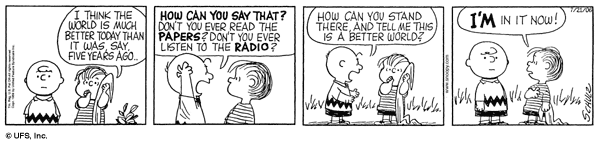
The World Is A Better Place Today


To view cartoon strip click on image. Enjoy.

Sunday, July 23, 2006

Management and Tapping Into Knowledge


Management can be defined as "getting things done through others." To be an effective manager you must be an expert at persuading and influencing others to work in a common direction. This is why all excellent managers are also excellent low-pressure salespeople. They do not order people to do things; instead, they persuade them to accept certain responsibilities, with specific deadlines and agreed-upon standards of performance. When a person has been persuaded that he or she has a vested interest in doing a job well, he or she accepts ownership of the job and the result. Once a person accepts ownership and responsibility, the manager can step aside confidently, knowing the job will be done on schedule.

You Have Two Choices
With most tasks, you have a choice of either doing it yourself or delegating it to others. Your ability to get someone else to take on the job with the same enthusiasm that you would have is an exercise in personal persuasion. It may seem to take a little longer at the beginning, but it saves you an enormous amount of time in the completion of the task.

Key Leverage Point
A key form of leverage that you must develop for success is other using other people's knowledge. You must be able to tap into the brain power of many other people if you want to accomplish worthwhile goals. Successful people are not those who know everything needed to accomplish a particular task, but more often than not, they are people who know how to find the knowledge they need.

What Knowledge Do You Need?
What is the knowledge that you need to achieve your most important goals? Of the knowledge required, what knowledge must you have personally in order to control your situation, and what knowledge can you borrow, buy, or rent from others?

Two Calls Away
It has been said that, in our increasingly information-based society, you are never more than one book or two phone calls away from any piece of knowledge. With computer services that are capable of accessing huge data bases including online databases all over the world, you can usually get the precise information you require in a few minutes by using a personal computer. Whenever you need information and expertise from another person in order to achieve your goals, the very best way to persuade them to help you is to ask them for their assistance.

Don't Be Afraid to Ask
Almost everyone who is knowledgeable in a particular area is proud of their accomplishments. By asking a person for their expert advice, you compliment them and motivate them to want to help you. So don't be afraid to ask, even if you don't know the individual personally.

Action Exercises
Here are three things you can do immediately to put these ideas into action.

First, multiply your output and rewards by persuading other people to do the job for you and do it well. Delegation is the key to personal leverage.

Second, identify the most important knowledge you need to do an excellent job and then concentrate on finding and using that knowledge.

Third, sign up for the next LMC to determine how good you are and to perfect the skill through the course's learning and practise sessions.

The person who can find the knowledge in others is often more valuable than the person who possesses it.

Saturday, June 24, 2006

10 Easy Ways to Know You're Not a Leader


I came across a nice list (from Tony Morgan) on leadership the other day.

"10 Easy Ways To Know You Are Not A Leader."

1. You're waiting on a bigger staff and more money to accomplish your vision.
2. You think you need to be in charge to have influence.
3. You're content.
4. You tend to foster division instead of generating a helpful dialogue.
5. You think you need to say something to be heard.
6. You find it easier to blame others for your circumstances than to take responsibility for solutions.
7. It's been some time since you said, "I messed up."
8. You're driven by the task instead of the relationships and the vision.
9. Your dreams are so small, people think they can be achieved.
10. No one is following you.

I believe this to be a good little list to enable leaders help take stock of where they are at and reassess their direction - and not get caught up in a loss of vision, responsibility and relationships.
I might add a few more to the list:

11. You are disconnected from the Spirit of God.
12. You don't take time to really listen to what others are saying.
13. No time to invest in developing other leaders.
14. You are increasingly making independent decisions.

I hope it helps you and others keep your eye on the goal through continual refocus especially in light of 7. "I messed up," which should produce redirected leaders, not just portray perfect ones. What are your thoughts?

Saturday, June 17, 2006

11 Leadership and Management Lessons From Guitar Playing


The cover story of the May 2006 issue of Guitar Player magazine is titled, "99 Ways to Play Better Now: Tips from your Favorite Guitar Players!" and it struck me that are many similarities with gutar playing and life.

See if you can connect the dots between what several of them said about music and what you already know to be true about life, leadership, management and success at work or play:

  • "Incorporate the feel of what someone plays into your style rather than the actual notes." - Bonnie Raitt

  • "The best performances are completely unselfconscious - where you're inside the music, and it's leading you and you just follow where it goes." - Bill Nelson

  • "Don't spend more time worrying about what it is you're supposed to be doing, rather than just doing the work. Once I was stuck while trying to write some new music, and I asked my friend Wayne Horvitz how he did it. He gave me a pencil sharpener. The moral? There are no short cuts, so stop whining and get on with it!" - Bill Frisell

  • "Tone has more to do with touch than gear." - Eric Johnson

  • "Get in touch with your uniqueness." - Ty Tabor

  • "All it takes is to hear a little improvement in your playing, and that little bit of inspiration is often enough to push you even further." - Wes Montgomery

  • "Don't be precious about anything - much less a certain guitar sound. There is always another interesting sound or effect just waiting to be discovered." - Robin Guthrie

  • "Listen more to the other players on the bandstand than you do to yourself," - Bill Kirchen

  • "Remember that the reputations of some of the greatest jazzmen ever are built on eight-bar solos. Too many guitarists play solos that are way too long." - John Hall

  • "Remind yourself that you're free to feel great instead of reserved or insecure. You automatically become a better musician in becoming a more aware individual." - Eric Johnson

  • "The enemy of inspiration is self-doubt." - Nels Cline


It all resonates with what is covered in the LMC - apart from being good stuff to remember.

Friday, June 16, 2006

Social Club or Transformational Powerhouse

I came across this quote from The Rev. Martin Luther King, Jr. on the position of the church:. It continues to be true in the 21st Century.

"There was a time when the church was very powerful-in the time when the early Christians rejoiced at being deemed worthy to suffer for what they believed. In those days the church was not merely a thermometer that recorded the ideas and principles of popular opinion; it was a thermostat that transformed the mores of society. . . . But the judgment of God is upon the church [today] as never before. If today's church does not recapture the sacrificial spirit of the early church, it will lose its authenticity, forfeit the loyalty of millions, and be dismissed as an irrelevant social club with no meaning for the 20th century. (Letter from a Birmingham Jail, p. 17)"

I see two problems which have made a course like LMC necessary: 1) Ministries or the church has a hard time communicating its message. 2) The message we do communicate often fails because our authenticity is in jeopardy.

Finding pleasure in the simple things


I feel like I'm starting to get all wound up again and long for the unwound and relaxed feeling of last Christmas. The other day I watched on amused as a couple of little kids amused themselves during a long train ride with each other and their imaginative worlds. This prompted me to take action and put a stop to work and just relax - a little bit of cooking and little light reading that evening. Its amazing how much fun it can be throwing around a ball or taking a walk around the neighborhood or park.

My RPMs have been reving pretty high the last few months, but I feel like I'm getting my margin back. I'm trying to enjoy the simple pleasures.

I was reading Matthew 6 and reflecting on two fascinating commandments. They aren't the kind of "commandments" we typically think of as commandments, but Jesus subscribed to bird-watching and flower-smelling.

Look at the birds--Matthew 6:26
Look at the lillies--Matthew 6:28

One of my goals is to do more bird-watching and flower-smelling. Some of it is scheduled. We have a picnic day and time out with colleagues over breakfast. But some of it is just spontaneous. Last Christmas was my time of winter adventure. I was really intentionally about turning everything into an adventure. I guess I am learning to enjoy a season of simple pleasures :)

Tuesday, June 13, 2006

You Don't Need A Title To Be A Leader

Kem Meyer in a one of her blogs makes an interesting observation that I quite often encounter as well - that of people blaming a lack of excellence in organizational change/communications due to their lack of power/influence in the organization.

She makes mention of Mark Sanborn's book: You Don't Need a Title to Be a Leader : How Anyone, Anywhere, Can Make a Positive Difference and shares a few foundation principles that he outlined about leading without being in charge that are true.

* Self mastery. [Develop your competence, character and connection.]
* Focused attention beats brains, brawn and technology every time.
* Power with people rather than power over people. [We shouldn't strive to be likeable or capable, but both.]
* Implementation Quotient. [Ability to execute.]
* Persuasive Communication Skills. [Influence, not force feed.]
* Giving. [Of yourself. Of your time. Of your knowledge.]


leading up, v. How to get things done and motivate others without formal authority; convincing or persuading colleagues/superiors of the need for action and involvement or leading when not recognized as a leader by virtue of power or position.

What are You Doing with Your Life?

Tom Peters (business and management guru) was speaking at an event in Dubai in September of last year when someone asked him the question: What have you been doing this year? Well, in typical Tom Peters fashion, he has responded. It's worth a few minutes of your day to download his response and then consider, what am I doing with my life? Have you identified your life mission?

There are helpful insights in Tom's response that might challenge your thinking on how you're approaching ministry as well. Stuff like "Deliciously designed gasp-worthy experiences" and "Women buy everything" and "Make it 'different,' not merely 'better.'" Do you think these statements and others included in this document have any bearing on what's happening or not happening in missions and the church?

Sunday, June 11, 2006

What's stirring?


I enjoy cooking. I love to mix ingredients together in just the right order and in the correct amount. Having the right amount of each ingredient in a recipe is critical to obtaining the taste of what you are preparing for a meal.

Timing is also critical. Being patient enough to let your bread rise fully once and then a second time will lend to a great tasting loaf of bread for your meal. Timing yields rich rewards just like fresh baked bread. As a result of patience and timing, one can enjoy the reward of fresh baked bread floating through the kitchen and the smell itself is almost as good as the taste. However with out the proper techniques this is not possible.

There are the proper techniques for baking, frying, boiling, and grill top cooking. Done correctly and you can produce a delicious array of meals that will keep your family coming back for more. Overall, quality cooking involves having the right ingredients, timing, and techniques to be successful. I want whatever meal I am preparing to have that certain taste or smell that calls out to everyone in my family and makes them hurry to the dinner table. Then I can both enjoy the meal and others joyfully partaking of what I have prepared.

On the flip side is a way of cooking that will not call out to others to join you at the dinner table. If the ingredients are not mixed properly it will ruin the meal you are preparing. Too much time in the oven or not enough will cause you to serve your meal late or have to prepare something else. If you misapply cooking techniques and fry what you should have been baked or boiled what should have been grilled you might get something that is far less appetizing and worse yet not recognizable as food.

There are so many combinations that you can put together to make a quality meal of food; likewise, there are so many ways you can ruin it when trying to cook.

Leadership is a lot like cooking. You can put together a quality recipe, follow that recipe, and produce a wonderful, appeasing meal. Or you can throw together a recipe that has a series of ingredients that don't work together, follow that quick fix recipe to ruin, and produce something both unsavory and hardly edible.

So as leaders we need to be careful of what we throw in the pot. No one wants a leader who can't cook for anyone - much less himself/herself.